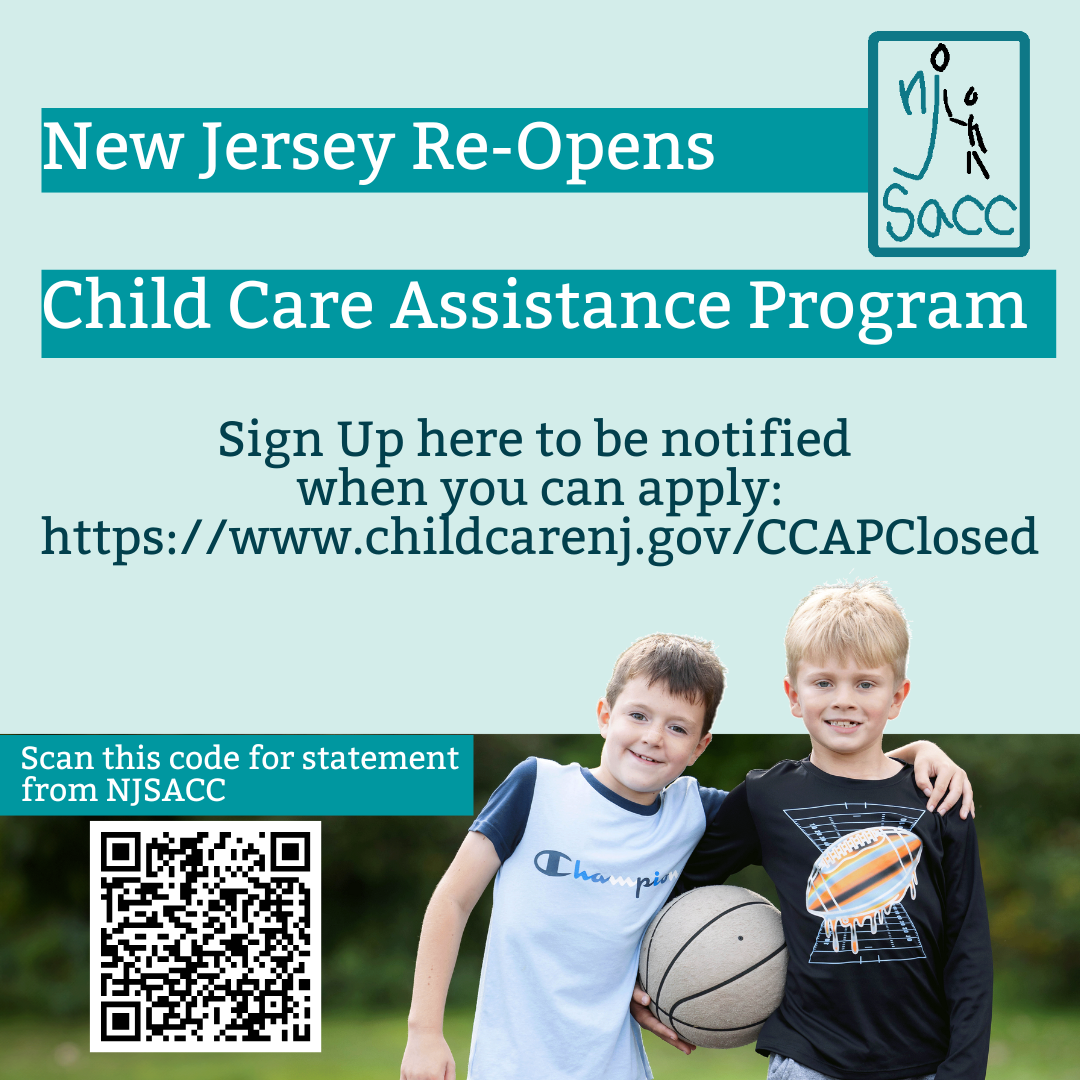
NJSACC Applauds the Reopening of New Jersey’s Child Care Assistance Program, Underscores Urgent Need to Sustain Support for Working Families
Westfield, NJ — NJSACC, New Jersey’s Afterschool and Out-of-School Time (OST) Professional Network, applauds the State’s decision to reopen the Child Care Assistance Program (CCAP) after months of an application freeze that left thousands of families without critical support. This action is a meaningful step toward restoring stability for working families who depend on child care to remain employed, continue their education, and maintain economic security.
As the state’s resource and system-builder for school-age child care, NJSACC emphasizes a crucial but often overlooked reality: federally, school-age children make up over 40 percent of all children served through CCAP, which is funded by the Child Care Development Block Grant (CCDBG). These subsidies allow families to access before-school, afterschool, and summer programs that keep young people safe, engaged, and learning beyond the traditional school day.
“Congratulations to our colleagues at ACNJ for leading this charge. The reopening of CCAP is a victory for all working families, who rely on the childcare continuum, early childhood, preschool, school-age, afterschool and out-of-school time programs every single day,” said Ebony D. Grace, Chief Executive Officer of NJSACC. “When families lose access to subsidies, they do not just lose child care, they lose stability. School-age programs are an essential part of the childcare infrastructure for working families across New Jersey.”
Recent data from the America After 3PM survey shows almost 60% of New Jersey parents said cost is the biggest barrier to child care. Nearly half cited accessibility, with programs being inconveniently located compared to home, school and work. Parents of more than 700,000 New Jersey children want after-school programs, but only around 150,000 are enrolled, according to the survey. These findings align with what OST providers see daily: child care access is not only a family issue, it is an economic issue. “There’s far-reaching impact that school-age childcare and afterschool has on the state overall and how we’re able to function and support our families,” according to Ms. Grace. “Children in low- and middle-income families are more likely to be without afterschool and school-age childcare. And it’s not because parents do not see the value of such programs; parents have to make tough decisions about what they can afford, especially as state financial support for childcare was decreased.”
NJSACC also extends deep appreciation to the policymakers who championed the reopening of CCAP and continue to advocate for long-term affordability solutions. “We are grateful for the unwavering support of childcare champions Senate Majority Leader Teresa Ruiz, Senator Britnee Timberlake, Senator Angela McKnight and Assemblywoman Shanique Speight,” Ms. Grace said. “NJSACC is a conduit to bring together stakeholders who support school-age childcare and resources. This is what it looks like when advocates, providers, and policymakers work together for children and families.”